Agentic AI: Beyond That Pilot and Into Production
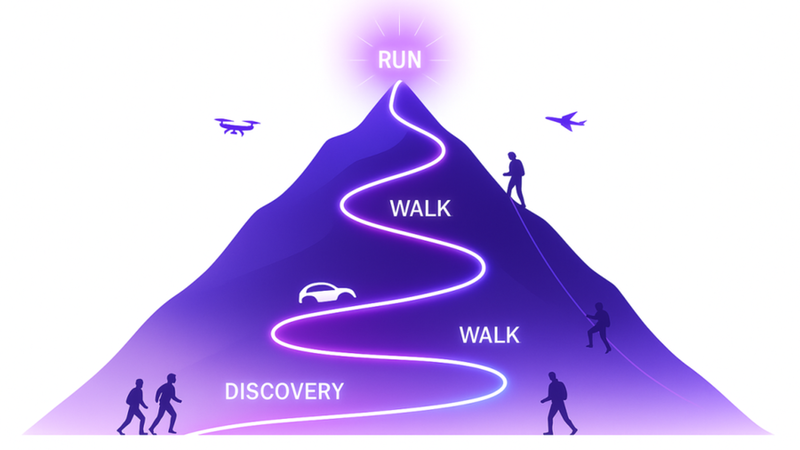
I’ve been working hands-on with Generative and Agentic AI solutions for well over a year now. Alongside partners like Google and Anthropic, I’ve built and tested a long list of MVPs. I’ve been fortunate to see first-hand the highs and lows of this technology’s evolution. Early on, there were many doubts: hallucinations, generic responses, weak semantic quality. Fast forward to the fall of 2025, and the tools have advanced dramatically. Yet one truth remains: getting from pilots to production is still the hardest part and the most ROI impact in any client business.
I know this journey all too well — because I’ve lived it. The excitement of spinning up a demo overnight is super exciting. AI demos run fine in a Jupyter notebook, even in CloudRun — but that’s not production 😑. Alas scaling those ideas, embedding them into systems, and re-engineering the production pipeline, the service support workforce and adopting new operating models to make them sustainable? That’s where the real challenge begins. And it’s precisely the challenge facing executives today.
We’ve proven the art of the possible with pilots. Now comes the pivotal moment: how do we scale responsibly? How do we integrate agentic AI into production in ways that deliver systemic, lasting value?
Fortunately, the relentless pace and growth and evolution of AI, the secondary, tertiary impact across all facets of business, technology and socio-economic structures (more on that later) - resulted in quite a few great reports and reports which we can now use to asses and evaluate the state of play, qualitatively - not just my personal experience coupled up with surveys.
The Mirror Effect of AI
The very latest Google DORA 2025 research, surveying nearly 5,000 professionals, highlights a paradox. On one hand, AI accelerates throughput — teams ship more code, more often. On the other, fragility increases: systems buckle under AI-scale velocity because organisations haven’t re-engineered the platforms, processes, and operating models that must underpin this shift.
“The report found that while 63% of teams accelerated delivery with AI, 57% also reported increased instability — highlighting the need for governance and CI/CD for agents.”
In other words: AI is not a tools problem. It’s an organisational problem. It acts as a mirror, amplifying strengths in mature teams and magnifying weaknesses where processes are brittle. High-performing teams with solid engineering practices find their impact multiplied. Teams with technical debt or fragmented processes see those problems magnified.
This reflection is unforgiving — but it’s also a roadmap. It shows us what must change if we want to turn AI PoCs into lasting enterprise value.
The AI Adoption Maturity Pyramid
Every enterprise sits somewhere along the adoption curve. At first glance, it looks like a simple four-stage journey: Discovery, Crawl, Walk, Run. But the real pivot comes at the dividing line between Crawl and Walk.
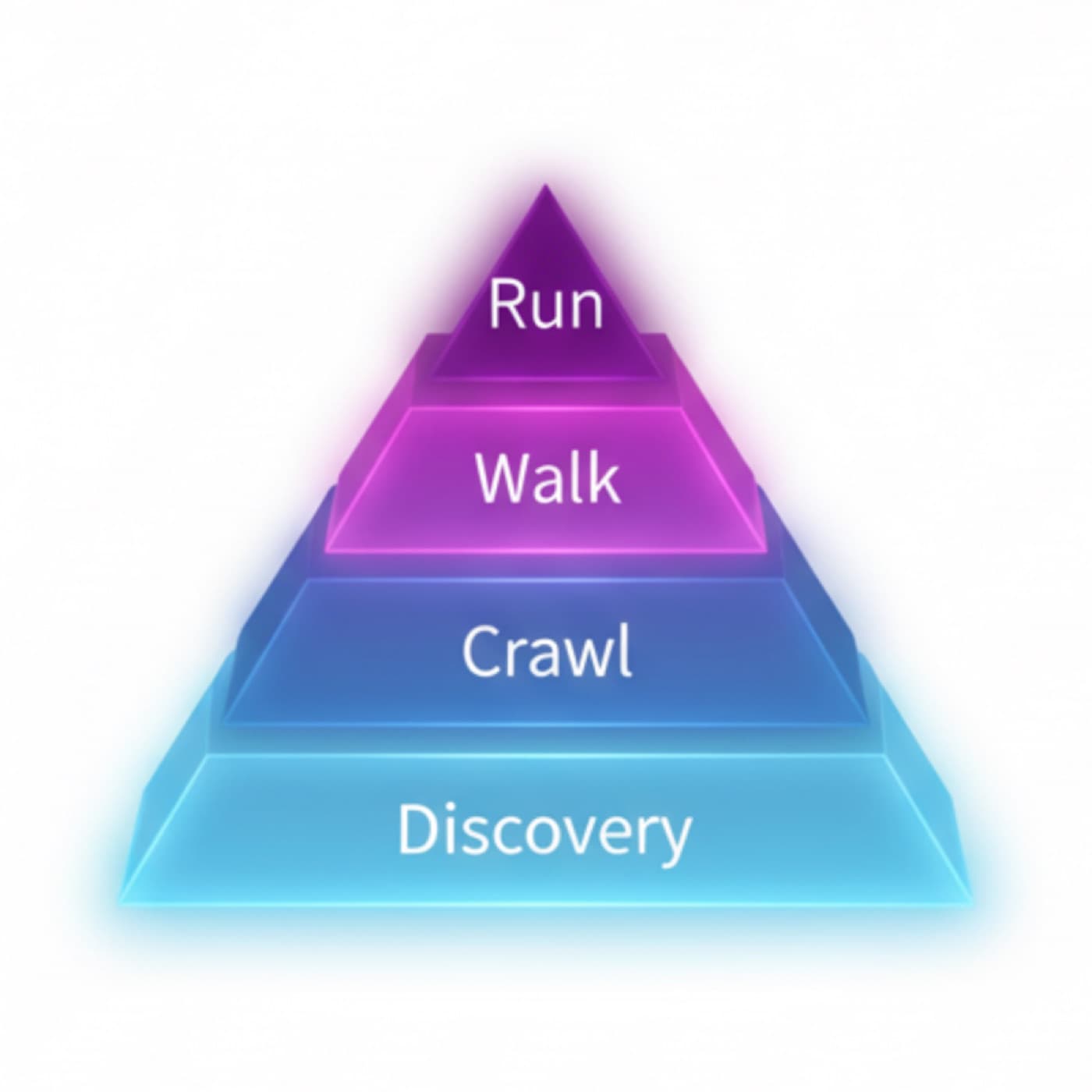
- Discovery and Crawl: the playground stages. Teams experiment with copilots and SaaS tools. Individuals gain productivity bumps, but value is fragmented and often lost downstream.
- Walk and Run: the production journey. Agents are integrated into CI/CD pipelines. Compliance, observability, and governance become first-class citizens. An AI Centre of Excellence (AICOE) emerges as the backbone for scale.
The DORA report confirms what we see in practice: moving from Crawl to Walk maturity states is the inflection point.
It’s no longer about tools (SaaS this or that); it’s more about systems, culture, and structure as key and pivotal differentiation factor
The Day Two: Where Production Work Really Begins
These PoCs and Pilots do impress. They get boardrooms excited. Rightfully so, because Ideas, capabilities and value delivery can be readily validated.
From experience and practice, a real practical 'wow' demo should take 2-6 weeks. Max. If you're still not sold on AI/Agentic business value impact we are all doing something wrong. It's my 2 cents, and it's my hard truth.
But the day after the demo — “The #Day2” — is where organisations stumble. Suddenly you face:
- Security and compliance: data privacy, regulatory adherence, vulnerability management.
- System integration: connecting agents across legacy IT, SaaS platforms, and data estates.
- Monitoring and observability: tracking reasoning paths, debugging behaviour, preventing drift.
- Team structure: avoiding bottlenecks and ensuring adoption doesn’t stall at silos.
These challenges aren’t solved by adding more copilots, or more demos. It's an Org Challenge, a Culture - People and Processes 101 - all over again.
They require a systematic approach: governance by design, AgentOps for evaluation, and platforms built for trust.
The AICOE as Platform
Just as the Cloud Centre of Excellence guided migrations in the past, the AI Centre of Excellence is becoming the foundation for enterprise-grade adoption. But it cannot be a bureaucratic gatekeeper. To succeed, it must act as a platform team.
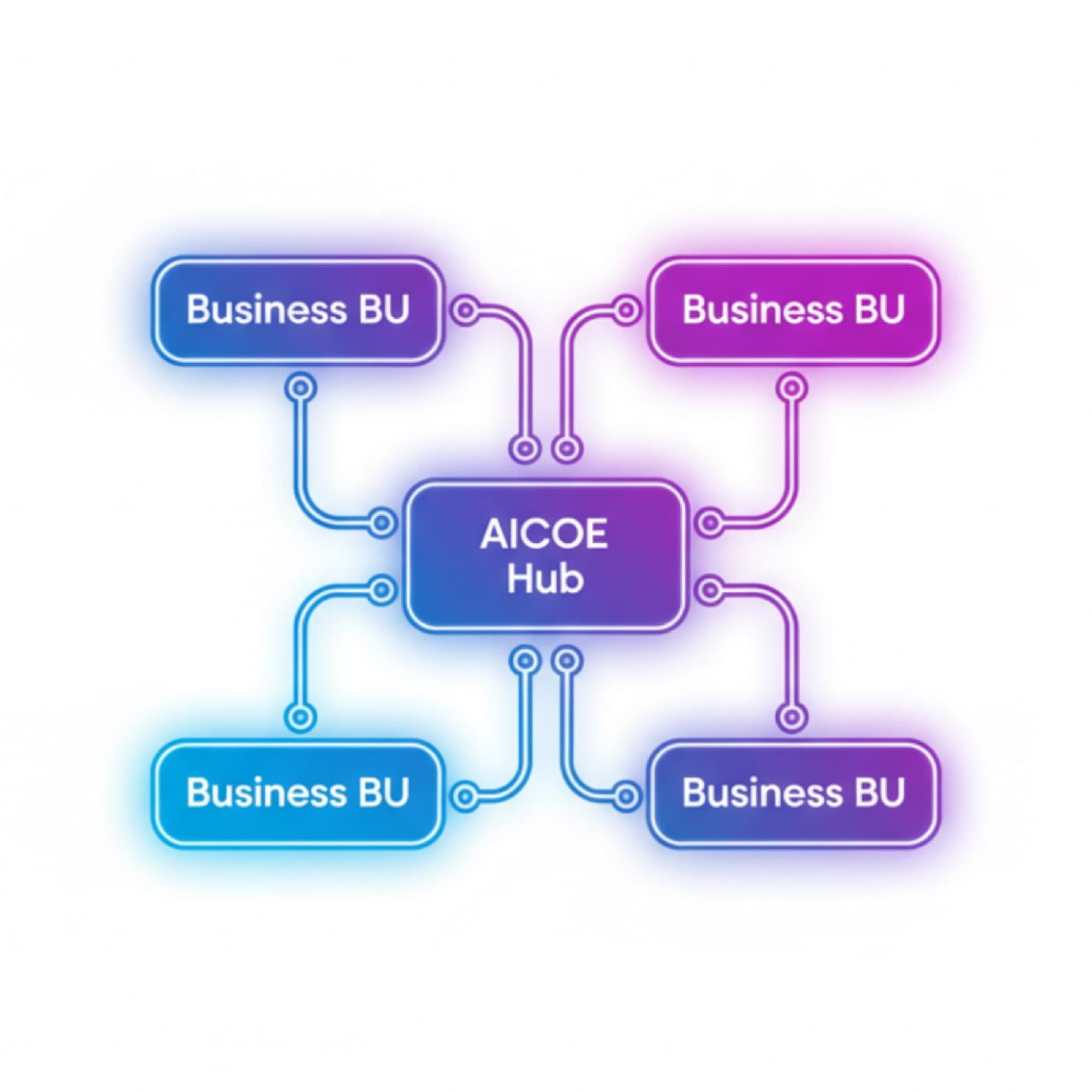
The AICOE Hub enables scale through:
- Defaults that accelerate — ready-made roles and evaluation feedback baked in.
- Guardrails that protect — integrated release and evaluation checks for safe adoption.
- Data strategy that governs — enterprise-wide alignment with security and compliance.
- Templates that scale — managed endpoints and blueprints for business units to run with confidence.
The hub provides “paved roads”: defaults, guardrails, and shared templates. The spokes — business units — consume these services, build domain-specific agents, and contribute improvements back through an InnerSource model. Done well, the AICOE operates like a product team inside the enterprise: enabling, not obstructing.
Your Agents Need CI/CD - Evaluation
Application code already benefits from mature DevOps pipelines. But AI agents, with their non-deterministic reasoning and ability to generate code or decisions at machine speed, require an equivalent discipline: AgentOps.
The 2025 DORA Report makes the paradox evident: AI increases throughput, but it also increases fragility. Teams ship more, faster — but without adapted control systems, downstream instability rises. Existing pipelines — designed for human-scale code delivery — can’t absorb the velocity, variability, or non-determinism of AI outputs.
What you don't want to start doing is to deliver code with vulnerabilities, faster.
Executives I’ve spoken with echo the same pain point: AI doesn’t just accelerate feature delivery, it also accelerates the propagation of vulnerabilities. A weak pattern in one team’s pilot can quickly spread across the enterprise if copied and scaled without consistent guardrails. Dora cited engineering lead put it as, “AI didn’t just help us write more code, it helped us ship bad practices ten times faster.”
The risk of incoherent adoption
The report warns — and industry anecdotes confirm — that inconsistent adoption patterns create a “shadow risk surface.” Different teams bolting AI pilots onto legacy workflows without a common standard produce fragmented silos of automation.
Instead of accelerating transformation, this accelerates:
- Vulnerability injection: insecure code paths enter production faster.
- Compliance gaps: undocumented reasoning paths break audit trails.
- Cultural drift: teams lose confidence as outputs differ wildly across units.
This above state of affairs is very evident in many Crawl Maturity State of the AI Adoption.
Practical implication
This means production-ready agents must be containerised, evaluated, and monitored as rigorously as any app and microservice. The difference is that the evaluation surface is bigger: correctness, safety, reasoning, and compliance all require codified tests and automated checks.
Done well, AgentOps turns AI from a fragile experiment into a systemic capability. Done poorly, it doesn’t just waste effort — it bakes fragility and risk into the enterprise faster than ever before.
Context Engineering: Turning Agents into Colleagues
An agent without context is ... stateless chatbot. But An agent with context is a colleague.
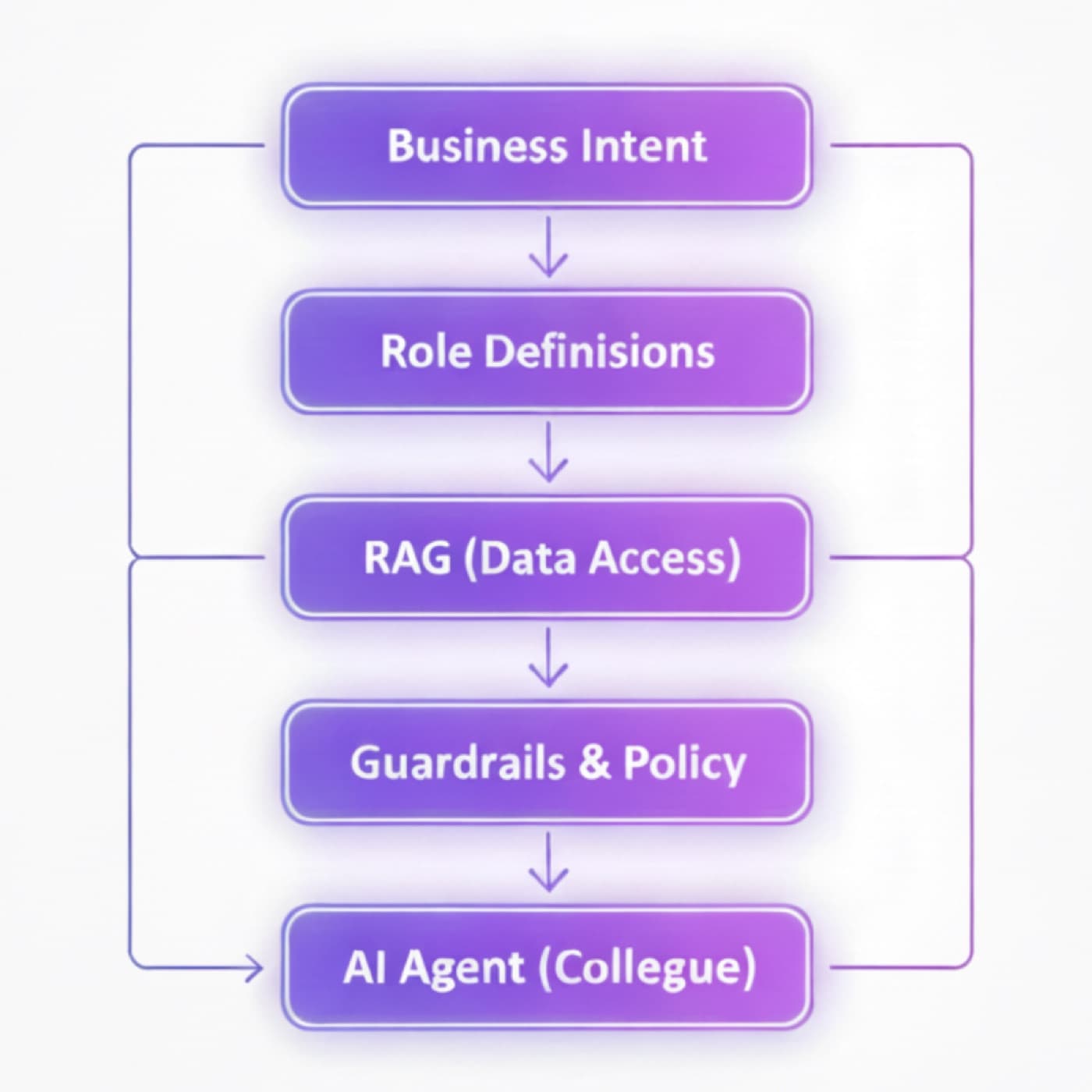
AI without grounding is like a new hire without onboarding. It produces outputs — often impressive — but with no alignment to business priorities, security standards, or regulatory requirements - or coherent Team's Ways Of Working. The result is short-lived productivity bursts that collapse when they hit downstream systems, or any degree of scale beyond few individual use cases.
Context Engineering closes that gap by embedding business intent, role clarity, and verifiable data into the agent lifecycle. It’s not just about connecting to a database; it’s about making the agent aware of how your enterprise works.
The layers of context
- Business intent: What outcome is this agent optimising for? Without this, agents chase novelty instead of value.
- Role definitions: SMEs codify scope, responsibilities, and boundaries. These “job descriptions” anchor the agent’s reasoning.
- RAG (data access): Retrieval-augmented grounding ties responses to verifiable, current, and proprietary data.
- Guardrails & policy: Security, compliance, and ethical guidelines baked into every output.
- Memory & feedback: Agents must recall past interactions and refine performance through feedback loops.
The risks of missing context
The report notes that fragile teams see AI create “localised accelerations that stall at scale.” A common anecdote: a QA agent that generates automated tests but doesn’t integrate with the CI/CD system. It looks impressive in isolation but delivers zero sustained value.
Or consider a compliance agent: without codified regulation, it generates outputs that sound legally sound but collapse under audit. In both cases, context isn’t just “nice to have” — it’s the difference between noise and systemic capability.
This is where (Human) Role Expertise comes to the front. Context Engineering is how domain expertise — in finance, oil & gas, legal, healthcare, or software — gets embedded into the agent framework. These in-house specialists SMEs are gold dust. They would provide the rules, data, and reasoning paths. AI scales them. They could and should own the Agent Resource definition - given such SMEs often have a great vantage point knowing what Good looks like.
Done right, context engineering transforms AI from a novelty tool into a trusted colleague. It’s the discipline that ensures agents don’t just work — they work the way your organisation works.
That said, this very streamlining the ways of working and organisational business context is really beneficial (sometimes overdue) for the Human colleagues alike.
Whether in oil and gas, legal, finance, manufacturing, or security, the main expertise provides the guardrails, orchestrates the flows, and ensures adoption is coherent with business value. Consulting organisations with cross-industry experience are uniquely placed here. They combine people, process, and technology — enabling enterprises to rewire operating models, not just optimise them.
The Roadmap to Production
Bringing all of this together, a production-ready roadmap must check off the following key areas:
✅ CI/CD for Agents ✅ Observability & Monitoring ✅ Governance by Design ✅ Context & Data Strategy ✅ Platform Integration (AICOE, Hub & Spoke)
These are not “nice to haves.” They are prerequisites. Without them, AI merely delivers localised productivity. With them, AI becomes a systemic force multiplier.
Closing point of view
AI now sits at the heart of enterprise transformation, but the mirror it holds is unforgiving. Those assumed undocumented processes, siloed need-to-know-whom gaps are now slowly being exposed across many enterprises. Sooner the better. AI Agents have the capability to optimise and even reinvent business processes to run a mile around your incremental KPIs
It reflects strengths and weaknesses in equal measure. The pace of innovation is relentless — and early movers who go beyond pilots today will build systemic advantage tomorrow. Those who delay risk finding themselves on the wrong side of volatility as industries reshape around them.
Early adopters would be creating compounding moat advantage. Slower movers will feel the volatility more acutely as business models and industries adapt unevenly.
But here’s the positive: The proverbial bizdev Pie is growing. As enterprises integrate Agentic AI into production, new opportunities, efficiencies, and innovations will multiply, and create yet more business opportunities and business models alike.
The opportunity is profound, do strive to leverage your Business Domain Experts with context, Adopt and Lead with innovative Central AI Platform, and drive culture of change. Be empowered to Re-engineer operating models.
Don’t just optimise — transform. The time to act is today.
And If you're starting out your journey, - do reach out and lets have a conversation, and see how we can help your enterprise move into the production era with Agentic AI.
Originally published on LinkedIn ↗. Republished here in full so it can be read without an account.
Jaroslav Pantsjoha
Technical Director · Agentic AI & Cloud Platforms · Google Developer Expert
Full bio →