Your Next Customer Isn't Human
Yes, It's getting a little tedious. You finally wrap your head around a new "way of working" with AI agents... only to have an even newer approach land weeks, days, or hours later. 😶🌫️
You're not alone, and keep up you must.
Google just launched Universal Commerce Protocol (UCP) with Shopify. OpenAI embedded shopping agents into ChatGPT. Then - Stripe launched Tempo — payment rails built for agent-to-agent transactions.
If you blink, you'll miss it. But this is important angle in this AI 4D Chess that is disrupting your business - and Your next high-value customer might not be even a person.
It might be another organization's agent, negotiating service terms, executing transactions, and evaluating quality — all without human intervention.
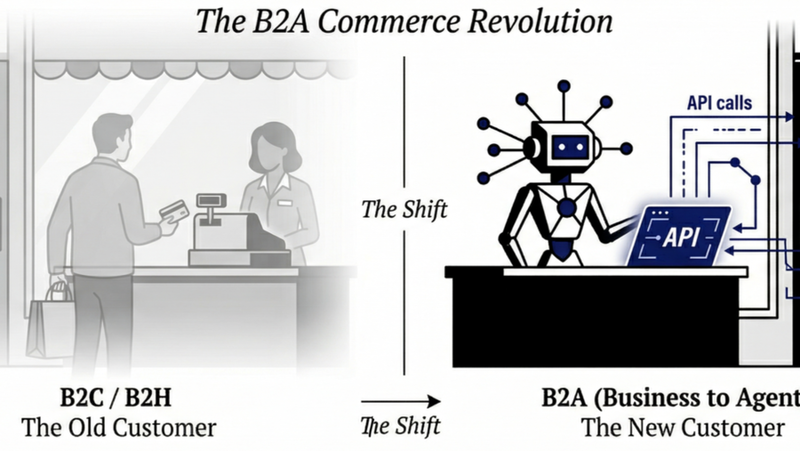
Welcome to B2A Commerce (Business-to-Agent). The market nobody is modeling correctly.
The Scale Nobody Is Pricing In
The AI agents market is projected to grow from $7.84 billion in 2025 to $52.62 billion by 2030, registering a CAGR of 46.3%. At the current rate, by 2033, projections reach $182.97 billion.
On the recent GMI Episode, Emad Mostaque, founder of Intelligent Internet, states that AI agents will outperform humans on most digital tasks by 2026. His prediction: "In the next 1,000 days, AI will make the entire structure of our economy obsolete." Ballsy.
Yet you cannot deny the change and pace of which has already been transforming global economies, circa 3 years in, since AI CE date of Dec 2023.
Google has already begun rewriting browser protocols for agent readability. Payment rails designed for agent-to-agent settlement — including Stripe's Tempo blockchain with Machine Payments Protocol (MPP) launched March 18, 2026 — are being deployed today, not in some distant roadmap.
The implication for product leaders is quite structural since your next high-value customer may not be a person, but It may be another organization's agent, evaluating your service, negotiating terms, and executing transactions — autonomously. (Hope you've started on AP2)
The Problem: Your Website Is (most probably) Useless to Agents
In 2026, your website is designed for humans:
- Shiny buttons
- Marketing copy
- Trust badges (all manner of unvetted variety of)
- "Request a demo" forms
In this new Era, An agent doesn't care about your hero image. It can't fill out your lead capture form. Your SEO-optimized blog post is opaque to machine discovery.
If your products cannot be discovered and consumed by an agent, whatever you're selling is pretty much invisible.
Let me introduce you to The next #SEO, - meet your #AEO (Agent Engine Optimisation).
Mini Case Study: The Autonomous Research Bureau
Imagine a High-Net-Worth Individual (HNWI) who employs a Personal Investment Agent running locally or on a trusted cloud.
This agent, can now;
- Scan the market for the best research providers
- Negotiate intelligence delivery terms
- Curate investment ideas across multiple sources
- Evaluate quality and synthesise recommendations
It doesn't visit your website. It doesn't read your marketing copy. It doesn't book a sales call.
It queries your Agent API. If you don't have one, you simply don't exist. (ok, I'm a little dramatic, just so you get the point - the least resistance factor wins. You can still rely on textBrowser, web search capabilities (whichever sites dont block) capabilities etc)
What B2A Commerce Requires
To play in the B2A market, your platform must speak "Agent." Here's what that means:
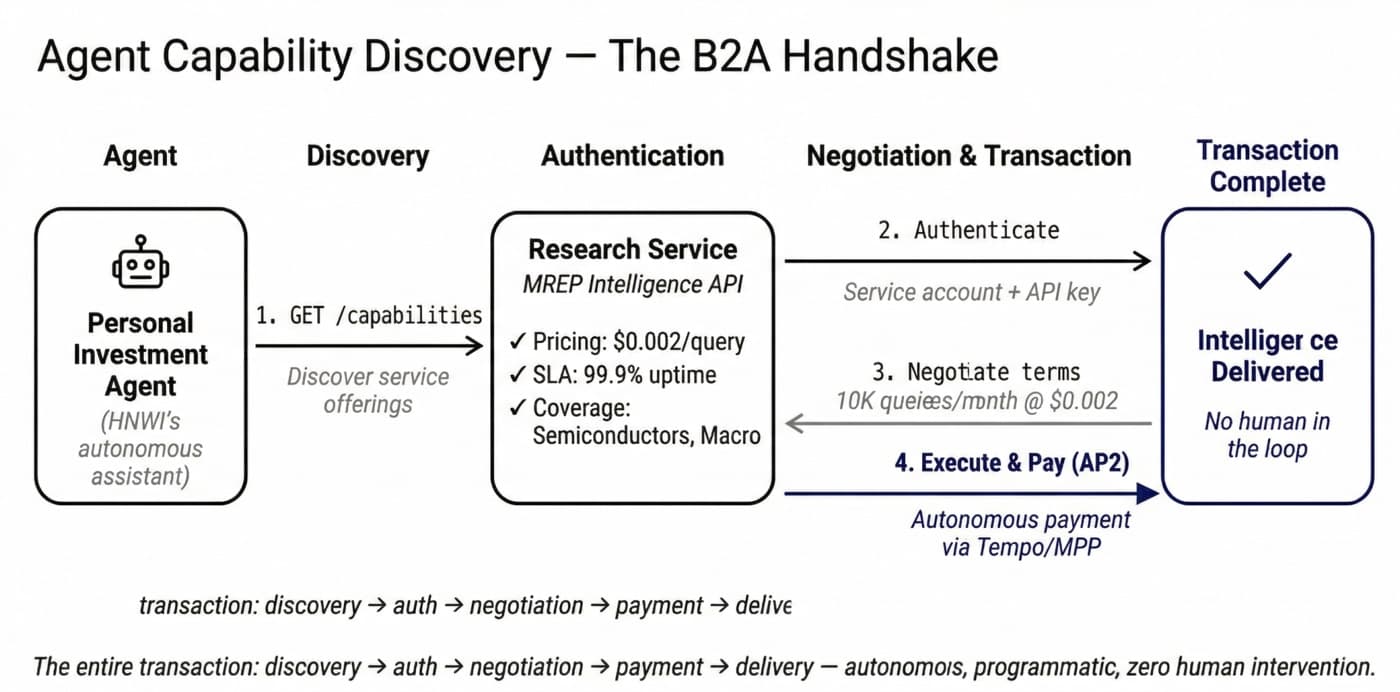
1. Capability Discovery Handshake - You can Imagine this
Your service must expose a machine-readable capabilities endpoint
Returns 👇🏻
- What you offer (research coverage, data feeds, API access)
- Pricing (structured, machine-negotiable)
- Latency SLAs
- Quality guarantees
- Auth mechanisms for agents
No PDF pricing sheets. No "Contact Sales" buttons. Brilliant.
2. Agent Authentication (Identity for Non-Humans)
Current auth flows assume a human with a browser, remember that it current does
- OAuth redirects
- 2FA SMS codes
- CAPTCHA challenges
B2A commerce requires agent identity, and it differss, as it asks for;
- API keys with scope-limited permissions
- Service accounts for agent-to-agent delegation
- Verifiable credentials (did:web, did:key)
- Audit trails (which agent acted on whose behalf?)
Google Cloud's Workload Identity Federation is the blueprint. If your auth system can't handle non-human principals, you may struggle to serve agent customers.
3. Structured Negotiation (No Human Sales Reps) 🤔
Agents don't take sales calls. They negotiate terms programmatically. (I can imagine there be an opportunity for programmatic agent based arbitrage opportunity here - similar to how Humans look/wait for Discount Codes and Vouchers to snap deals)
Your API may now also support:
- Pricing negotiation: "I need 10K queries/month at $0.002/query. Can you meet this?"
- SLA negotiation: "I require 99.9% uptime. What's your guarantee?"
- Contract terms: Machine-readable terms of service (not 40-page PDFs)
The Universal Commerce Protocol (UCP) — now integrated with Google Cloud and Shopify — is the standard emerging for agent-negotiated transactions, endorsed by over 20 global partners including Visa, Mastercard, Stripe, Target, and Walmart.
If your pricing model requires a human to quote, that's the delay that may just cost you the B2A customer.
4. Agent-Readable Documentation
Your API docs are written for developers (humans). They include:
- Prose explanations
- Code examples
- Tutorials
Agents need:
- OpenAPI specs (machine-readable)
- Semantic annotations (what does this endpoint DO, not just what it returns)
- Capability catalogs (I need "sentiment analysis" — which endpoint provides it?)
For example, Google Cloud's API Hub is solving this. Your API documentation needs to be semantic, not just syntactic.
The Commerce Stack for B2A
Here's the protocol stack that makes B2A commerce work
Google Cloud + Shopify UCP integration (announced January 11, 2026 at NRF) makes this real. ChatGPT's embedded shopping agents make this visible to consumers. Stripe Tempo with Machine Payments Protocol (launched March 18, 2026) makes settlement frictionless.
What This Means for Your Product Strategy
If you're building enterprise software, SaaS products, or B2B services, here's the strategic shift:
1. Budget Reallocation
The capital previously allocated to:
- Front-end development → morphs into API governance
- UX design →morphs into Context curation
- App maintenance →morphs into Agent orchestration
The line item shifts, morphs from "build the app" to "operate the intelligence."
For a mid-size enterprise spending 30-40% of IT budget on application development, this reallocation is material. The skill profile changes with it. (PS good luck with that)
2. Vendor Relationship Restructuring
Today, enterprise software contracts are structured around:
- User seats
- Feature access
- Release cadences
In the agentic model, contracts are structured around:
- Outcomes delivered
- API calls consumed
- Intelligence quality SLAs
- Latency guarantees
Procurement teams negotiate for accuracy, latency, and outcome delivery — not dashboard features.
Vendors that cannot express their value proposition in outcome terms become invisible to agent-mediated discovery.
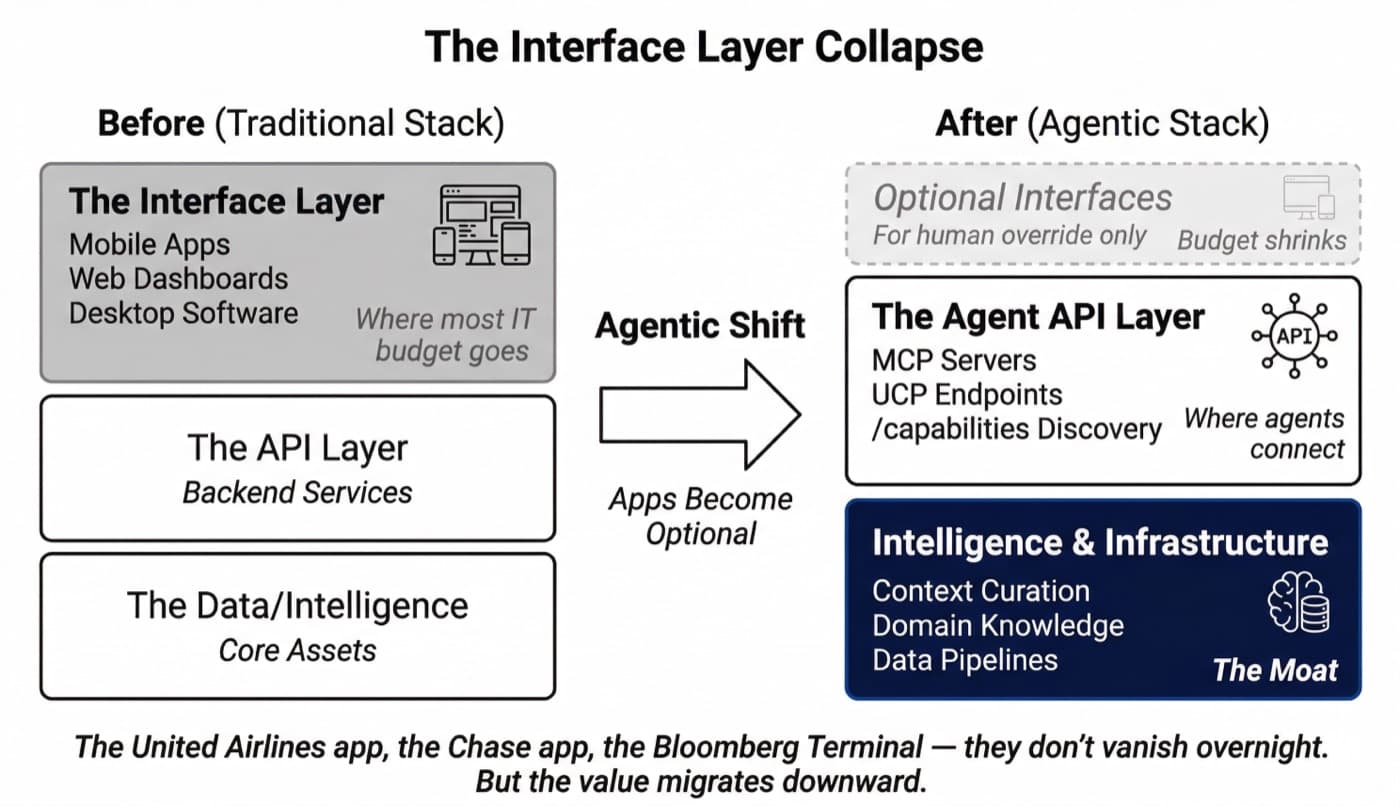
3. The Interface Layer Collapses (Eventually)
If I have an agent that can:
- Book my flights ?
- Pay my bills ?
- .. Curate investment research
Wait ...why do I need the United Airlines app, the Chase app, or the Walgreens App?
The Interface Layer collapses. The value migrates to:
- → The Intelligence (The Agent)
- → The Infrastructure (The Rails — Data Providers, Intelligence Networks)
The "Middlemen Apps" don't vanish overnight. The change is in the wind, but you better explore this further, as the trend is evolving, - to focus the API and the Intelligence, not (just) the App.
Welcome to Hyperpersonalised Commerce you've been promised
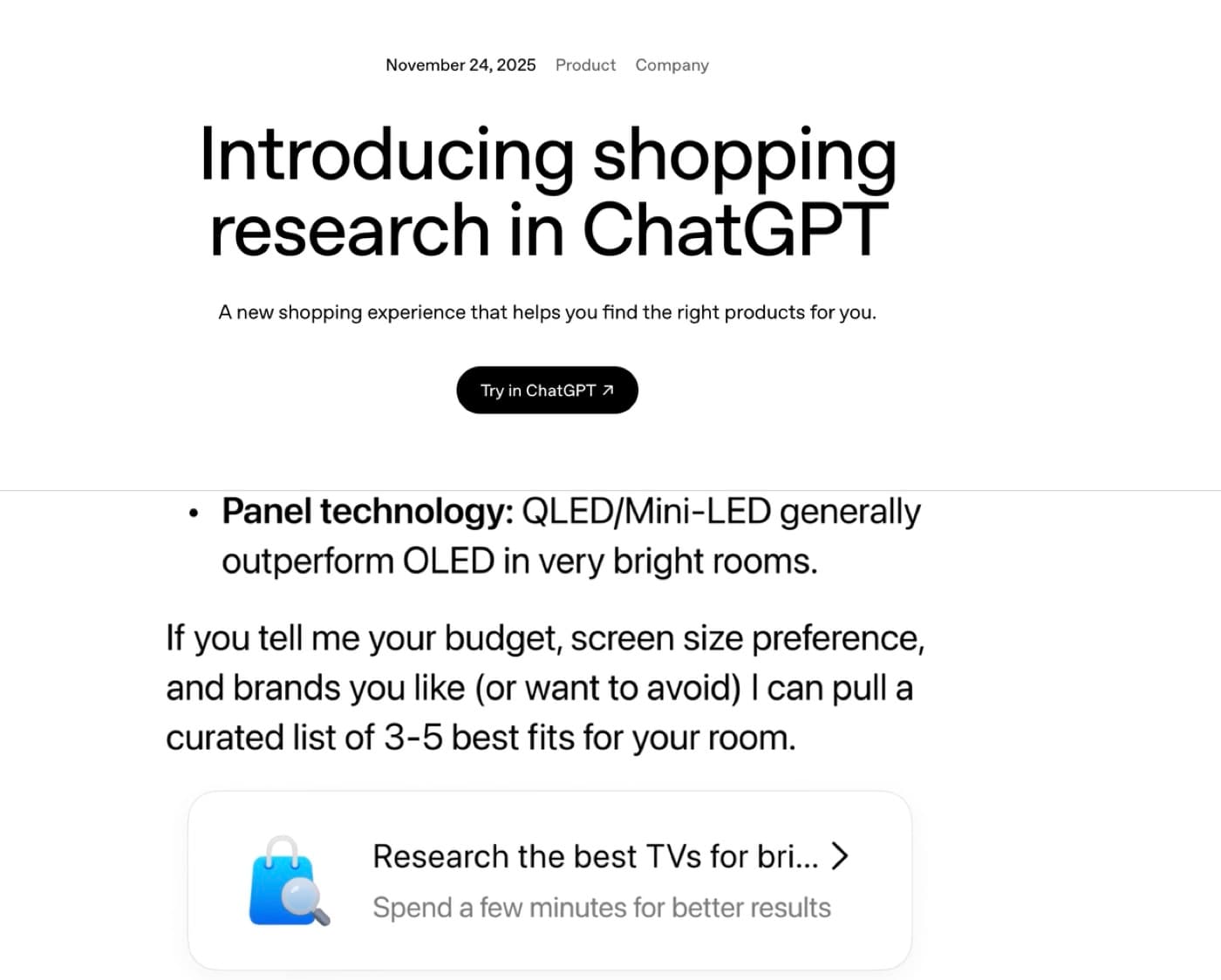
Surprise! (not) The ChatGPT Shopping Agent is already doing this. openai.com/index/chatgpt-shopping-research
What's Next?
B2A commerce is not just a more 2030 'prediction' (i admit there are a few). But if Last year it was all about MCPs, and Agents, then this year 2026+ would be about mutli-agent workflows, and hyper-personalisation. Here is the idea of recent trend of announcements on this topic;
- Google Cloud + Shopify UCP integration is live (launched January 11, 2026)
- ChatGPT shopping agents are deployed across Shopify's Agentic Storefronts
- Stripe Tempo with Machine Payments Protocol is processing agent-to-agent payments (launched March 18, 2026)
- Visa is extending MPP to support card-based payments on its global network
TLDR - The infrastructure is here. The protocols are standardising. The TAM is plenty.
Are you building for it?
Or are you still optimizing your hero image and "Request a Demo" button?
The future of commerce is autonomous.
If you ARE building for this agent-powered shopping experiences, and agent-transactions, do share, like, follow.
Happy to chat and exchange notes on what works, what does not, and learn together.
JP
Originally published on LinkedIn ↗. Republished here in full so it can be read without an account.
Jaroslav Pantsjoha
Technical Director · Agentic AI & Cloud Platforms · Google Developer Expert
Full bio →