The New Ways of Working: The Applied AI Engineering Role
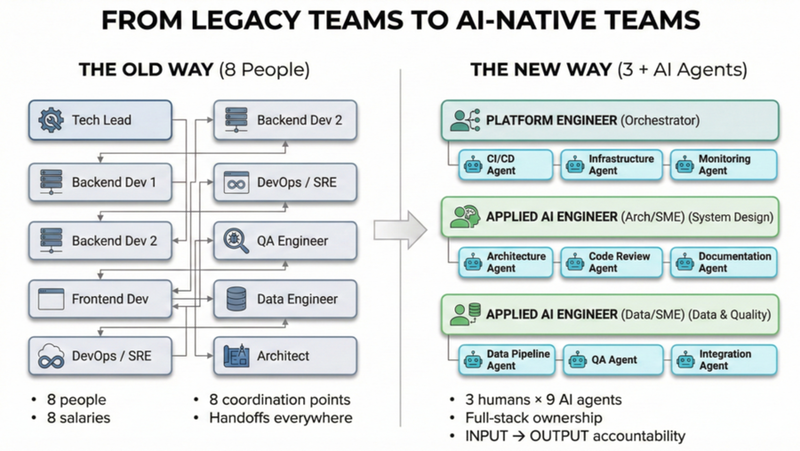
First, All opinions are my own.
Now I'll say this, The hiring is broken.
We're still recruiting for specific role titles and designations that are becoming obsolete — not in years, but in months. Sometimes weeks.
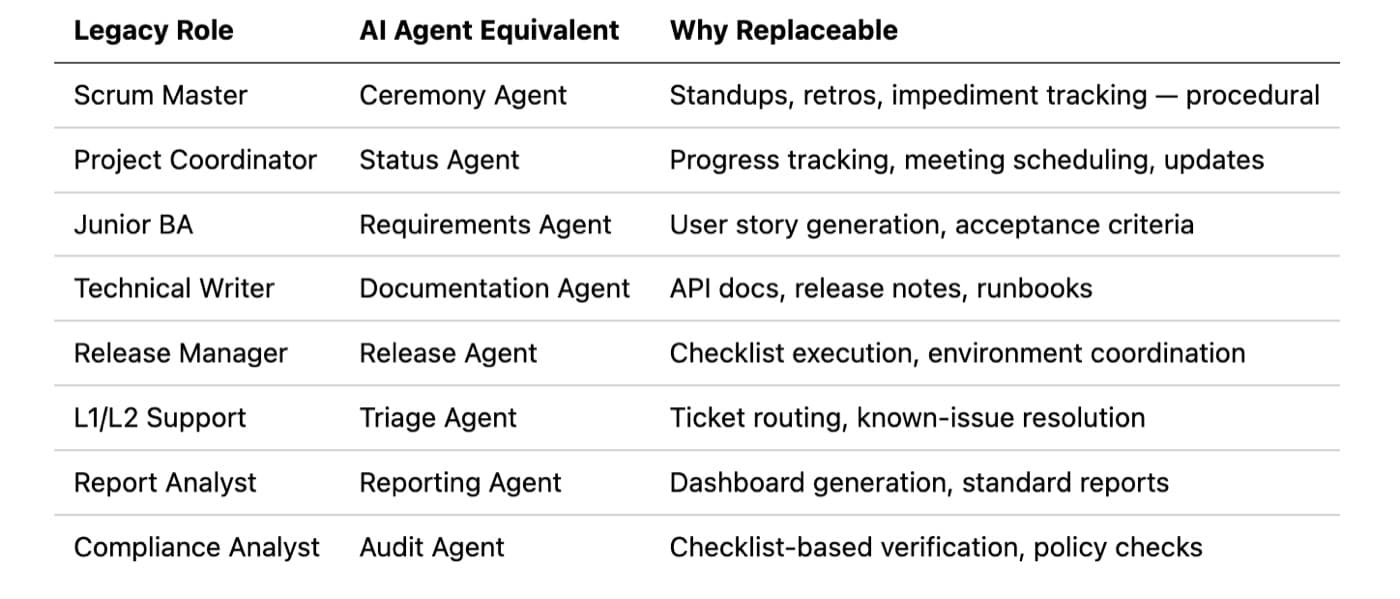
Take Scrum Master. Pull up the role definition. Now ask yourself honestly: can this be done by an AI agent?
Not automated. Not assisted. Replaced.
I'm not picking on Scrum Masters. They're the canary in the coal mine. The uncomfortable truth is that many BAU (Business As Usual) roles face the same question.
If a role CAN be done by an AI agent, it PROBABLY WILL be done by an AI agent.
No point fantasising that all roles are equal. They're not. Some go quicker than others.
Welcome to the Edge
When we face this reality — this disregard-for-fancy-titles reality, now the questions become about about adapting to rapid change:
- What is the new role?
- How do we hire for it? [ And yet, will the role change after the hire?]
- Where do titles start to blend and responsibilities expand?
I've spent the last two years deep in the AI ecosystem — at multiple projects, industry events, in conversations with peers, building my own projects hands-on, and across my professional network. Every other week, - the same question comes up:
"What is the ONE skill we need to hire for now?"
And every week, like shoving a square peg in a triangle hole re legacy categories:
- "Should we hire ML engineers" — sure, 100% amazing skills, but how does this help in SaaS solution rollout?
- Worse, " Should we hire prompt engineers" — prompts are disposable; and this isn't a discipline per se [happy to argue over it]
- Even worse still "Should we hire an AI/ML hire" - a cardinal sin, as if it's the thing which may as well fall under general 'magic' umbrella
These are legacy or often too niche, too specific. They made sense when AI meant building models from scratch. But that era is ending. AI is becoming a service you consume, not a capability you build.
None of these roles, alone, builds the Agentic Enterprise.
The era of Applied AI Engineer
I believe we're witnessing the emergence of a priority title — not yet established, but already necessary.
I call it Applied AI Engineering.
This is not a recombination of existing roles. It's a synthesis. A just new discipline.
What Applied AI Engineering Requires
The Applied AI Engineer owns the full flow: from input to output, with production as the destination.
This is the key difference from legacy roles:
- Software Engineers build the middle, don't own input or output context
- ML Engineers optimise models, don't take systems to production
- Data Scientists experiment, don't navigate governance
- Applied AI Engineers see it through: input → build → output → production
Notice what's missing: ML Engineering. Model training is becoming a niche specialism. Applied AI Engineers consume AI as a service — and I don't these regular demand for hyperparameters optimisation and tuning.
While the old gag line was "jack of all trades, master of none." The new reality is jack of all trades, master of one — broad across the full flow, but a relative expert in your originating domain.
Who Becomes an Applied AI Engineer?
They're already in your organisation. They're the people who've been there, done that, shipped to prod:
- SREs who know what good looks like
- DevOps engineers who've survived production incidents
- Senior software engineers with product sense
- Platform engineers who are battle-scarred
- Architects who've taken ideas from whiteboard to production
These are T-shaped people. Deep in one discipline. Broad across the others. And critically — they've built things that run.
Building on Shoulders of Giants
The Applied AI Engineer doesn't build from scratch. They consume AI as a service and build value on top:
- Google Cloud, Vertex AI, Gemini Enterprise, ADK
- The LLM foundation is a commodity — consume it
- The orchestration foundations is a solved problem — leverage it
- The value is in what you build on top — own it
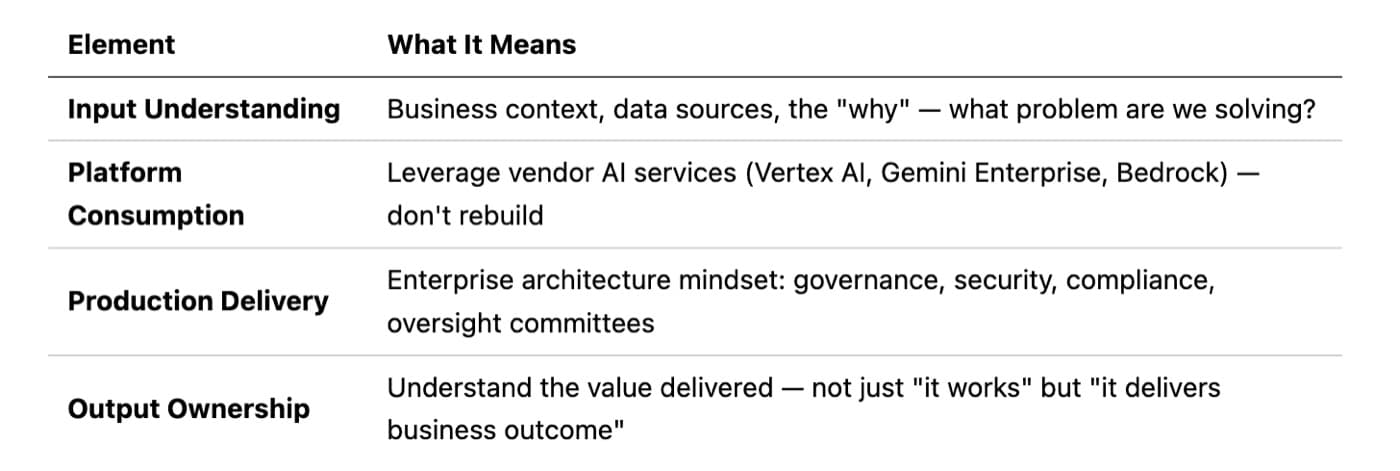
This is how progress works. Every generation builds on what came before.
Mainframe → Client-Server → Web → Cloud → AI-as-Service. Each layer abstracts up. Each layer requires new skills.
ML Engineers build the platforms. Applied AI Engineers build on the platforms. Different roles. Different skills. Different hiring criteria.
What They Actually Do
They own the full flow — input to output, into production:
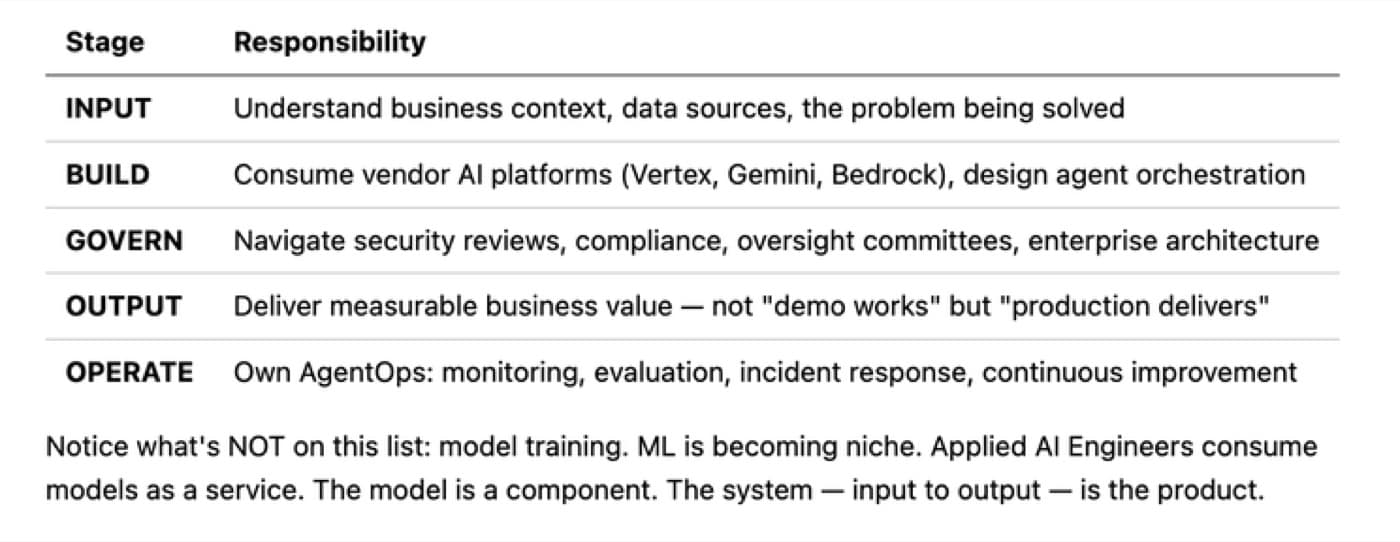
Applied AI Engineers consume models as a service. The model is a component. The system — input to output — is the product.
Visualising the Role
The Applied AI Engineer owns the intersection of four capabilities, mapping to the full flow 👇🏻
The four capabilities:
- INPUT — Understand business context, data sources, the "why"
- BUILD — Consume vendor platforms (Vertex AI, Gemini, Bedrock)
- GOVERN — Navigate enterprise architecture, security, compliance
- OUTPUT — Deliver measurable value, own production operations
There's another, more common visualisation: the T-shaped individual. Same idea. Depth in your origin discipline, breadth across the new stack.
The T-shape never really left. We just stopped looking for it.
The Hiring Implication
Stop hiring for titles. Start hiring for aptitude.
What to look for:
- Track record of shipping
- Comfort with ambiguity
- Ability to hold multiple disciplines in their head
- Domain expertise that can become curated context
What to stop requiring:
- Exact role match (the roles are changing)
- Deep specialism in a single discipline (synthesis > depth)
- Prompt engineering as a skill (it's a tactic, not a discipline)
You'd be right to call out 'that's mighty strong opinion, noh'
Well, PoC time is over. How do I know this works? Well, I've seen it done. Here's a reference implementation of an AI-native developer experience — the tooling, the workflows, the governance patterns that make this real 👉 github.com/jpantsjoha/ai-native-developer-experience It's production-adjacent infrastructure.
But But But... What about university degrees?
That's a whole separate post. 😶🌫️ Short version: universities teach disciplines, not synthesis. This role requires T-shaped people, not I-shaped graduates. But that's controversial enough for another 1,000 words.
The Bottom Line
We're hiring for titles that won't exist in 18 months. ok, ok, harsh - but hear me out.
Legacy demand won't vanish overnight — not for a while longer, anyway.
RPA scripts will still run. ETL pipelines will still flow. What will change is who builds the next layer — and it won't be the roles we're hiring for today. check out 👉 openclaw.ai — Local-first personal AI with tool access. Consumer-grade agentic AI is already here.
The enterprise is 18-24 months behind the consumer. We always are.
The roles we need — Applied AI Engineers — don't have established job descriptions yet. They're emerging. The people who will fill them are already in your organisation: the SREs, the platform engineers, the senior devs who've shipped to prod.
Find them. Train them. Keep them. And Give them the mandate to build.
"If it can be done by an AI agent, it probably will be done."
The question is: who will orchestrate those agents?
Originally published on LinkedIn ↗. Republished here in full so it can be read without an account.
Jaroslav Pantsjoha
Technical Director · Agentic AI & Cloud Platforms · Google Developer Expert
Full bio →