Navigate Business Challenges: Your Guide to a Strategic Platform Launch

There is a lot of #GenAI Disruption underway, even as I pencil this up-to-date version of my post in early 2024. I appreicate this post does not come with the necessary mandatory #genAI prefix. Yet This Business Challenge is real, With and Without GenAI. The problem statement still often comes down to Enterprise Readiness, Enterprise Adoption - People and Processes in place - to adopt whichever relevant technology for the most effective and successful use cases.
I am talking about Internal Enterprise Platforms, which can facilitate accelerated technology adoption within the context and guard rails of the organisation’s policies.
These ecosystems need careful consideration and the right foundations need to lay in place, to ensure such a Platform is a resounding success, with measurable Return on Investment. (And Indeed, to prove successful rollout and adoption, one ought to measure the relevant “every” metric)
Below, I’ll reflect on my earlier (more technical version) of this post I have written at Contino - a Cognizant Company, and explore the High Level Guide on how an organisation can effectively leverage Platforms to deploy solutions and applications at scale, and where such foundations are necessary to ensure your business is in the best position with a successful container Platform Launch.
I look to outline the path towards the Platform Development and its Release Journey, breaking this large topic into separate sections that you can jump into;
- Why it Matters - The High-Level View
- Business Readiness and PaaS Adoption
- Centre of Excellence, SRE & Platform Engineering
- The ‘First’ Principles & Frameworks
- High-Performance Development & Delivery through Platform Adoption
- How do You get started?
- Conclusion & Reach out for a coffee :D
Why Platforms Matter
Organisations navigate the digital landscapes, and the de facto need for agility, scalability, operating efficiency and leaner time-to-market is paramount. In the Application Development landscape, there is an increasing interest in leveraging a form of a Cloud-Native Application hosting so-called Container Enterprise Platform as a Service (PaaS) solutions.
The success of such a Platform Build and holistic Adoption, however, is not necessarily all-technical and hinges on its alignment with the organisation's own transformational strategy, but also cultural shifts and stakeholder buy-in that will drive that org-wide holistic change.
Some of the typical Business Requirements to baseline Context;
- Agility and Scalability: Organisations need to rapidly adapt and scale, making the agility and scalability of platforms critical.
- Operating Efficiency: Streamlining operations is a key driver for adopting these platforms, directly impacting the bottom line and offering standardised cost optimisation.
- Leaner Time-to-Market: With the increasing pace of market demands, a platform that enables quicker deployment is invaluable.
"Organisations are racing to modernise in the cloud era, yet many grapple with aligning their cloud migration strategies to their core business objectives. This rush often leads to cloud cost escalations and limited ROI, with cloud agility and governance being relegated to afterthoughts, resulting in a disconnection between technology investments and business outcomes." Mark Faiers
Business Readiness and PaaS Adoption
Launching an application-hosting platform is a complex task.
It involves combining strategy, operations (OPS), and a focus on the people (DEV) using the platform. This blend is what makes a platform successful.
It meets current needs and is ready for future challenges and opportunities. This approach turns the platform into a strategic tool that aligns with the broader goals of the organisation. It's about more than just adopting new technology; it's about being prepared for the future of technology and encouraging continuous improvement and innovation.
In preparing for platform adoption, thus we explore how Site Reliability Engineering (SRE) principles, the Cloud Centre of Excellence (CoE), and Developer Experience (DevEx) do and can work effectively together. These elements need to align to create an effective development environment.
Why should businesses develop and launch a platform based on Kubernetes and container orchestration? A strong Cloud CoE and solid SRE practices are important, but they need to work in a way that supports your business objectives. The CoE guides the strategy, while the SRE ensures the operations run smoothly and uses the technology to support the wider goals of the organisation.
The key to success ironically lies in the quality of such in-house Developer Experience (DevEx). A good DevEx helps users to be more innovative and efficient. It includes providing the right tools and a supportive environment for developers. This means having automated workflows, secure coding practices, and a culture that encourages learning and collaboration.
The process of launching a successful platform involves combining the strategic approach of the CoE with the operational strength of SRE and enhancing it with a good DevEx. This approach ensures that the platform is not only technically sound and reliable but also supports innovation. Each element – strategic vision, operational reliability, and creativity – is important to ensure a holistic Business Success.
Role of Centre of Excellence, SRE & Platform Engineering
This Business and re-organisation journey towards cloud adoption and platform success is the strategic alignment of its cloud strategy. This strategy should be comprehensive, answering fundamental questions such as:
- Is there an established and mature Cloud Adoption process with dedicated cloud estate management?
- Are teams in place to lead and champion the platform initiative effectively?
- And what is the role of the Centre of Excellence, which encompasses best practices in security, networking, compliance, and governance, is crucial. It should be in alignment to support the delivery of this internal service within the organisation.
The ‘First’ Principles & Frameworks
While the SRE function ensures operational reliability, the CoE guides the strategy using frameworks like DORA (DevOps Research and Assessment) and CAF (Cloud Adoption Framework) for optimal cloud adoption practices.
Let me unpack The Frameworks.
The Cloud Adoption Framework (CAF), is something of a best practice guide that is offered by major cloud providers like AWS, Microsoft Azure, and Google Cloud. It covers various dimensions from business and technical aspects to people and process considerations. The CAF provides guidelines on strategies and design principles for effective cloud (components) adoption.
Conversely, the DORA Framework focuses on the principles and practices that drive high performance in software delivery and operational performance. It underscores the importance of Dev+Ops practices, continuous delivery, automation, and a culture of continuous improvement, - central to the Developer Experience (DevEx). With People playing the central key role, as the crux of an organisation, this is where the emphasis of focus is.
High-Performance Development & Delivery through Platform Adoption (and Automation)
Have the strategic objectives established and clear, as in the Example below: “We want a Platform which can leverage to scale, support our developers to build and launch new products and services, - that we can delight our customers with” The intersection of SRE principles and the guidance of the Cloud CoE, especially when adopting frameworks like CAF and DORA, is the foundation for organisations pursuing operational excellence in the cloud.
These frameworks, while serving different primary purposes, are crucial in their convergence, particularly in the context of container platforms and meeting SLA targets.
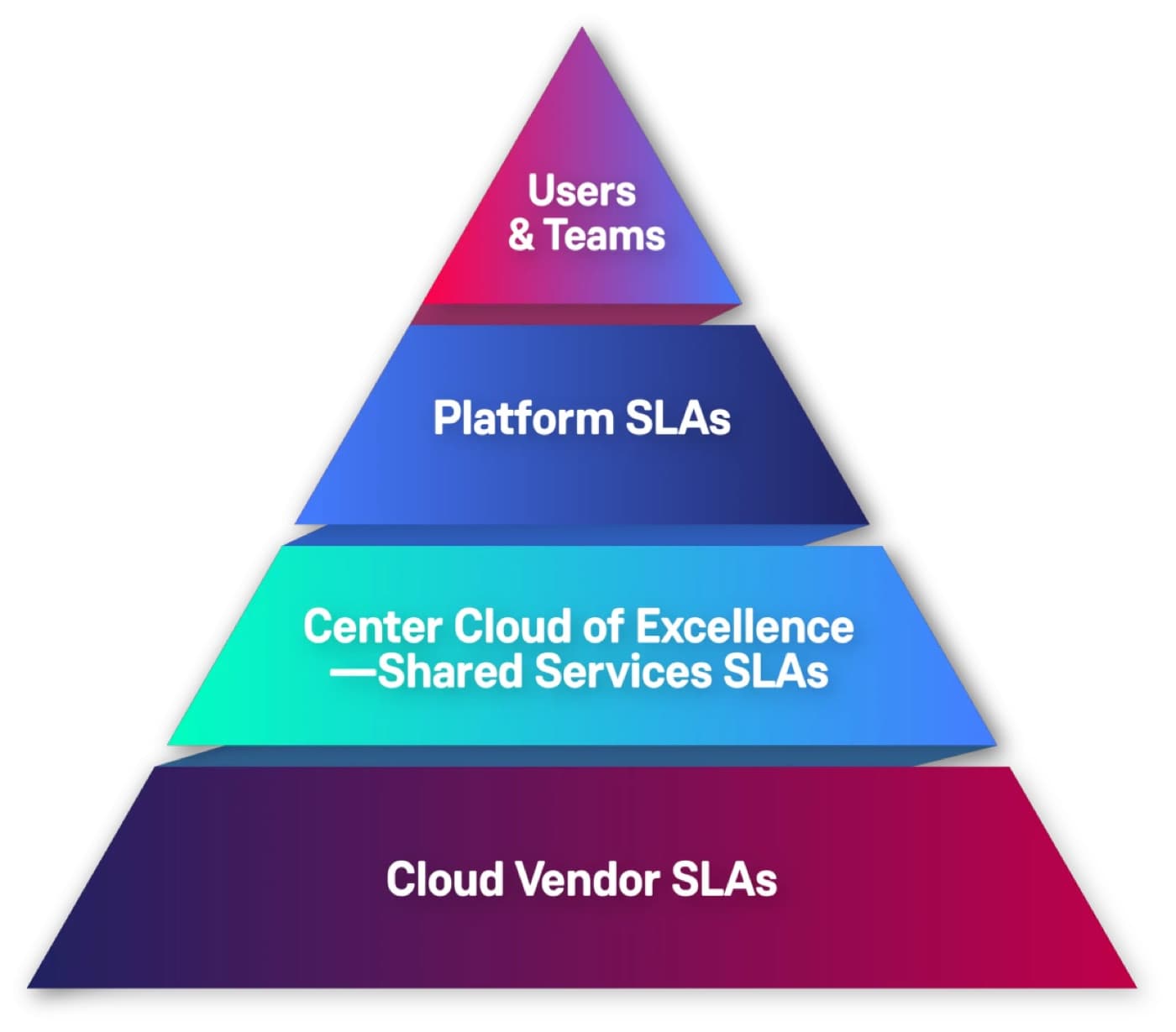
This convergence is not just about technical alignment; it's about fostering an environment where strategy, operational reliability, and a superior DevEx coalesce to drive holistic business success. And How do we get started achieving success in the aforementioned Mission Statement?
‘Just’ Getting Started?
A critical starting point is evaluating infrastructure readiness. First and Foremost this encompasses assessing the current state of security and compliance, development and operations integration, and cost management, including cost center attribution. Governance, risk management, resilience, and recovery capabilities also form an integral part of this assessment. Each of these areas plays a pivotal role in ensuring the platform is built on a solid and secure foundation. Nicholas Kinch
Platform ORKs, Development Cadence and Metrics
To ensure the platform meets its initial objectives, such as faster time-to-market, I would advocate the importance to establish clear metrics and responsibilities, particularly across cross-functional teams:
- Performance Metrics: Implement metrics to track and measure key performance indicators like time-to-market for new products, developer productivity, and customer satisfaction with new services. These metrics will provide tangible evidence of the platform's impact and success.
- Collaborative Development: Ensure a collaborative approach where the CoE, SRE, and DevEx teams work in unison. Each team should understand their specific roles and how they contribute to the overall objective. It's important to get this right to get the team both skilled and enabled on the path to success. Ensure to hold regular cross-functional meetings and clear communication channels.
- The need for Great Communication will be critical.
- Continuous Evaluation and Improvement: Adopt an iterative approach to platform development and rollout. Find internal early adopters of such a platform. Even with the alpha release enabling and supporting the early users, those pioneers will be able to provide fast feedback for Platform releases 0.0.1 and onwards. This will help validate assumptions and ensure the “features” invested into the Platform development are real and have tangible, measurable ROI.
- Automate Everything: The Security Scan, The Platform Build. The Code Scan, The Local, Remote Build, The Integration Test, and The Unit Tests, the BDD Tests, User Acceptance Test, Doc Generation. As much as sensibly (GenAI) possible - do it.
- Build Business Value - Not Vanity Metrics (Great write up David Rollason) This is my personal Favourite, ensure your team is measuring the right metrics which measure the business value outcomes. The Platform needs to deliver value, and every investment for a feature, a requirement has a real cost associated. Seek to have a real user to validate such requirements.
- Don't forget to be celebrating Platform Launch and Adoption wins - however small, within your own organisation, to get momentum going.
- From Experience - There is always more to add here. Alas, I promised to keep this High Level, and now I digress in detail.
In short, much effort is to be spent on continuously evaluating the platform development performance against set metrics, and be open to making adjustments as necessary. This could involve tweaking operational processes, enhancing developer tools, or re-aligning strategies with evolving business goals.
Release and break platform often. Especially that Alpha, Beta Versions
"To harness the true potential of cloud technology, a 'cloud-smart' strategy is essential. This approach prioritises thoughtful workload assessment, strategic cloud adoption, and aligns IT with business strategy, ensuring cloud investments not only foster agility but also deliver tangible business value. It's about intelligent modernisation, where agility, cost-efficiency, and strategic alignment converge to drive long-term success."
Wrap up time
The lessons learned from navigating the landscape of container platforms – a landscape as varied and complex as the CNCF’s technology offerings – are profound.
It's more than just implementing a “Technical Solution”, it’s about intricately weaving this technology into the very fabric of an organisation. “Technology is the easy bit” line I am sure you’ve heard enough of in your circles.
If you're poised to explore the world of container platforms and ensure effective rollouts, our team is here to guide you. Let's start a conversation and embark on a journey that resonates with your unique business objectives. Discover our success stories and thought leadership insights, showcasing our expertise and the impactful results we deliver.
Join us in redefining what it means to be cloud-smart, where strategic modernisation meets agility, cost-efficiency, and long-term success.
Reach out, to have a chat if this topic resonates, let's have a conversation.
Originally published on LinkedIn ↗. Republished here in full so it can be read without an account.
Jaroslav Pantsjoha
Technical Director · Agentic AI & Cloud Platforms · Google Developer Expert
Full bio →